When I was in Norway this summer, I met with several relatives, and many had pictures or objects that had belonged to our ancestors. Here is my gg-grandfather Emil Samuelsen Haugen's cane. This treasure isn't mine, but I took a few nice pictures of it.
Thursday, September 30, 2010
Tuesday, September 21, 2010
The Basics of Italian Genealogy Research
The LDS familysearch Web site is an essential "add" to the genealogist's "favorites" list of links. Here, I want to highlight one very nice feature, which is the "online classes" available for viewing from the comfort of your computer.
Below is a link to a nice video that teaches about Italian records research. It is very informative and easy to follow -- you will learn about records that are available for order from the family history library in Salt Lake City, Utah, and how to search for your ancestors. Several topics are discussed in detail, including Italian birth, marriage, and death records, as well as military records. To view the video go to:
https://fch.ldschurch.org/WWSupport/Courses/FHLExport/Italian_Research_LX/Player.html
Below is a link to a nice video that teaches about Italian records research. It is very informative and easy to follow -- you will learn about records that are available for order from the family history library in Salt Lake City, Utah, and how to search for your ancestors. Several topics are discussed in detail, including Italian birth, marriage, and death records, as well as military records. To view the video go to:
https://fch.ldschurch.org/WWSupport/Courses/FHLExport/Italian_Research_LX/Player.html
Tombstone Tuesday -- Giuseppa Napoli
Saturday, September 18, 2010
Hellebæk Sawmill in Kongsberg, Norway
![]() |
| Click on picture for better viewing. |
The picture is from the early twenties, and one can see the Kjerrat, a bridge where the timber was transported from the river into the sawmill. There is also a narrow road going north, behind the Sawmill. As I indicated earlier, the house of Emil and Hanna was on the right side of that road, and therefore hidden behind the sawmill building.
Thank you, Odd, for sharing!
Wednesday, September 15, 2010
Wordless Wednesday -- Giuseppa Napoli and Sister
Monday, September 13, 2010
Tombstone Tuesday
Sunday, September 12, 2010
Progen Study Group -- Month 1
Today, I met with 11 other professional and aspiring professional genealogists in my Progen course. This class is 18 months long with about 6-10 hours of homework a month and one online meeting a month. To learn more about the program, you can check out the site: http://progenstudy.org/. The great thing about the course is that it's free, with the exception of the text book (see picture) and a $30 fee for access to the Progen database, which holds messages, files, assignments, and the chat room.
The book we are studying and discussing is Professional Genealogy: a Manual for Researchers, Writers, Editors, Lecturers, and Librarians, edited by Elizabeth Shown Mills. The chapters we read for this month were:
•Chapter 1 – Defining Professionalism by Donn Devine, J.D., CG, CGI
•Chapter 5 – Ethical Standards by Neil D. Thompson, LL.B., Ph.D., CG, FASG
We also had two assignments to complete, which will undergo peer review. In other words, I have to review the assignments of the others, and they review mine. This month I have to write a mission statement and a genealogy resume. I have completed these assignments, although they aren't due until the end of the month. I found writing both of these very useful for defining my focus area and experience, and I can see more clearly what I need to work on, too.
I will continue to post on this course monthly. Thanks for tuning in!
The book we are studying and discussing is Professional Genealogy: a Manual for Researchers, Writers, Editors, Lecturers, and Librarians, edited by Elizabeth Shown Mills. The chapters we read for this month were:
•Chapter 1 – Defining Professionalism by Donn Devine, J.D., CG, CGI
•Chapter 5 – Ethical Standards by Neil D. Thompson, LL.B., Ph.D., CG, FASG
We also had two assignments to complete, which will undergo peer review. In other words, I have to review the assignments of the others, and they review mine. This month I have to write a mission statement and a genealogy resume. I have completed these assignments, although they aren't due until the end of the month. I found writing both of these very useful for defining my focus area and experience, and I can see more clearly what I need to work on, too.
I will continue to post on this course monthly. Thanks for tuning in!
Wednesday, September 8, 2010
Genealogy Goals for the Fall
Tina Lyons (her blog) posted her genealogy goals for the fall. Good idea, Tina. Here are mine:
1) Scan, scan, scan. I still have so much to scan.
2) Organize, organize, organize.
3) Work on my Italian line. I have ordered a bunch of microfilms from the Family History Library, which should arrive any day now.
4) Order more Italian records when I am finished with this batch.
5) Write/order documents from Italian municipal buildings in Catania, Palagonia, and Mineo.
6) Continue sourcing my Norwegian line.
7) Develop another genealogy Web site I have had in mind.
8) Work hard on my 18 month Progen (Professional Genealogy) course. I am so excited about this course!
9) Try and make it to a genealogy conference or expo of some kind. I think there is one in Atlanta soon.
10) If I find the money, take a trip to the Salt Lake City Family History Library (this is not likely to happen, but I can dream:).
11) Work on my Norwegian family history book.
12) Continue to pursue descendants of common ancestors/relatives and share information and pictures.
13) Convert tapes of my Italian grandmother telling stories (from the 70s and early 80s) to CD, and see if a major noise reduction is achievable.
14) Finish transcribing my Italian grandfather's diary (written in 1915 when he was 15 years old) into computer text, and also translate it into English (this may take a while).
15) Update my files with the information I learned during my trip to Norway this summer.
16) Develop my genealogy library, and read more books.
17) Oh, there is more to do, but I will stop here.
What is your list?
1) Scan, scan, scan. I still have so much to scan.
2) Organize, organize, organize.
3) Work on my Italian line. I have ordered a bunch of microfilms from the Family History Library, which should arrive any day now.
4) Order more Italian records when I am finished with this batch.
5) Write/order documents from Italian municipal buildings in Catania, Palagonia, and Mineo.
6) Continue sourcing my Norwegian line.
7) Develop another genealogy Web site I have had in mind.
8) Work hard on my 18 month Progen (Professional Genealogy) course. I am so excited about this course!
9) Try and make it to a genealogy conference or expo of some kind. I think there is one in Atlanta soon.
10) If I find the money, take a trip to the Salt Lake City Family History Library (this is not likely to happen, but I can dream:).
11) Work on my Norwegian family history book.
12) Continue to pursue descendants of common ancestors/relatives and share information and pictures.
13) Convert tapes of my Italian grandmother telling stories (from the 70s and early 80s) to CD, and see if a major noise reduction is achievable.
14) Finish transcribing my Italian grandfather's diary (written in 1915 when he was 15 years old) into computer text, and also translate it into English (this may take a while).
15) Update my files with the information I learned during my trip to Norway this summer.
16) Develop my genealogy library, and read more books.
17) Oh, there is more to do, but I will stop here.
What is your list?
Monday, September 6, 2010
Tombstone Tuesday -- Vincenzo Dibennardo (Di Bennardo)
Thursday, September 2, 2010
Norway, Days 13, 14, and 15
On Day 13, we set out on a two-day non-genealogical tour. However, for all I know my ancestors visited or lived in the areas we were to visit. My father really wanted me to see Western Norway, which has some of the most spectacular landscapes in the world. All my life I have visited the Oslo area and not ventured far from there, so this was going to be a real treat. So, early that morning, we headed to Luster on the Sognefjord, where we had reserved a cabin. HINT: cabins are the economical way to see Norway. They are located in campgrounds, but can be very nice with all the amenities included.
On the way, we stopped to see the Borgund Stave Church located in Borgund, Lærdal, Norway. It is one of only 28 stave churches remaining today and one of the best preserved. A stave church is a medieval wooden church; these churches were Catholic before Lutheranism came to Norway. All of the surviving stave churches are in Norway, with the exception of one in Sweden and one Norwegian stave that was relocated in 1842 to the outskirts of Krummhübel, Germany, now Karpacz in the Krkonoše mountains of Poland (Wikipedia).
After a lovely drive, through some of the prettiest country I have ever seen, we arrived in Luster. The cabin we rented was right on the fjord, which was one giant mirror to the surrounding mountain landscape. The weather was perfect -- not too cold or hot -- and the sun shone through the occasional cloud. I went down by the water where there was a bench, and I thought this would be the perfect place to learn to meditate or find peace in your life.
One very nice surprise was the Dale stone church that was built in Gothic style in the year 1250. It was open to the public during evening hours, and what a treat. It was absolutely gorgeous, and, recently, wall drawings dating back to before the Reformation were found during renovation. Some may even go back to the 12th century.
After a nice night in Luster, we started the 3 hour drive to Geiranger, Norway. The route would take us through the beautiful Jotunheimen mountain region. Luckily, the weather was great, which allowed for spectacular views of the Norwegian fjord country. We also drove down the Boeverdal and pass just below Galdhoepiggen, the tallest mountain in Norway. And when we arrived at the overlook that showed us the beauty of Geiranger below, it was like being in a fairytale because it was almost too beautiful to be real. In fact, it is so exceptionally beautiful that it is included on the UNESCO World Heritage List. The Geirangerfjord is located in the southwestern part of the county of Møre og Romsdal, north in Fjord Norway, approximately 100 kilometres from the town of Ålesund.
After taking several pictures from above Geirangerfjord, we drove down through the town and looked for the campground where we had rented a cabin. The cabin had two bedrooms, a living area, a kitchenette, and a lovely view of the fjord. We could sit on the porch and watch the boats and ships go by. Later, we went to town and walked around. It was really cute and filled with tourists, especially since there was a cruise ship parked on the water in front of the town. After shopping for some dinner, we headed back to the cabin to cook it. The plan was to rent a boat after dinner, but, unfortunately, the sun gave in to rain clouds, and by the time it passed, it was too late. But my son and I went and played ping pong for a while before observing a beautiful sunset and turning in for the night.
The next day, we had to say goodbye to Geiranger and take the route toward Oslo and our return to the United States. Again, the scenery was lovely -- waterfalls, rivers, lakes, mountains. I was particularly enthralled by the glacier blue color of the rivers. The water everywhere looked like a child had picked out a turquoise crayon out of the box and colored it into the landscape, which had somehow magically turned into reality.
From the moment we arrived in Norway, striking scenery played before our eyes. But I have to say, the two days I spent in Western Norway, taking in the aqua-blue color of the fjords and rivers, rocky cliffs with spouting waterfalls, and the dark green vegetation surrounding primary-colored houses dotting the landscape were simply stunning. And when you have a family history belonging here, it is even more special.
Thanks for taking the journey with me through my blog! Unfortunately, I could not post all my adventures in Norway, but I plan to sprinkle my blog every so often with a lovely picture from this trip -- perhaps Treasure Chest Thursday would work. This trip was truly a treasure to me.
| One of many pretty views on the way to Borgund Stave Church |
| Borgund Stave Church |
After a lovely drive, through some of the prettiest country I have ever seen, we arrived in Luster. The cabin we rented was right on the fjord, which was one giant mirror to the surrounding mountain landscape. The weather was perfect -- not too cold or hot -- and the sun shone through the occasional cloud. I went down by the water where there was a bench, and I thought this would be the perfect place to learn to meditate or find peace in your life.
| Views from our cabin in Luster |
One very nice surprise was the Dale stone church that was built in Gothic style in the year 1250. It was open to the public during evening hours, and what a treat. It was absolutely gorgeous, and, recently, wall drawings dating back to before the Reformation were found during renovation. Some may even go back to the 12th century.
| Dale Church in Luster |
| Artwork dating to before the Reformation |
| The altar in Dale Church |
| In the high country, on the way to Geiranger. Notice the glacier in the background. |
After a nice night in Luster, we started the 3 hour drive to Geiranger, Norway. The route would take us through the beautiful Jotunheimen mountain region. Luckily, the weather was great, which allowed for spectacular views of the Norwegian fjord country. We also drove down the Boeverdal and pass just below Galdhoepiggen, the tallest mountain in Norway. And when we arrived at the overlook that showed us the beauty of Geiranger below, it was like being in a fairytale because it was almost too beautiful to be real. In fact, it is so exceptionally beautiful that it is included on the UNESCO World Heritage List. The Geirangerfjord is located in the southwestern part of the county of Møre og Romsdal, north in Fjord Norway, approximately 100 kilometres from the town of Ålesund.
| My Dad poses with Geiranger below him |
After taking several pictures from above Geirangerfjord, we drove down through the town and looked for the campground where we had rented a cabin. The cabin had two bedrooms, a living area, a kitchenette, and a lovely view of the fjord. We could sit on the porch and watch the boats and ships go by. Later, we went to town and walked around. It was really cute and filled with tourists, especially since there was a cruise ship parked on the water in front of the town. After shopping for some dinner, we headed back to the cabin to cook it. The plan was to rent a boat after dinner, but, unfortunately, the sun gave in to rain clouds, and by the time it passed, it was too late. But my son and I went and played ping pong for a while before observing a beautiful sunset and turning in for the night.
| Sunset view from our Cabin... circa 11:00 pm |
| The cabin... |
| The blue color of the water looked like it came from a crayon box |
From the moment we arrived in Norway, striking scenery played before our eyes. But I have to say, the two days I spent in Western Norway, taking in the aqua-blue color of the fjords and rivers, rocky cliffs with spouting waterfalls, and the dark green vegetation surrounding primary-colored houses dotting the landscape were simply stunning. And when you have a family history belonging here, it is even more special.
Thanks for taking the journey with me through my blog! Unfortunately, I could not post all my adventures in Norway, but I plan to sprinkle my blog every so often with a lovely picture from this trip -- perhaps Treasure Chest Thursday would work. This trip was truly a treasure to me.
Tuesday, August 31, 2010
Norway, Days 11 and 12
On Day 11 in Norway, we took a tour of different farms in the area of Baerum, Norway, where ancestors had lived. Some of the farms I visited were Bryn, Løken, Grorud, Skollerud, Burud, Bye, and Jordbaerhaugen. Bryn, Burud, Løken, Skollerud, and Jordbaerhaugen are mostly important to my Christopherson (Kristoffersen) line I often blog about. This line goes back from my grandmother's father. Grorud and Bye are farms in the line of my grandmother's mother. There were other farms I was not able to visit because of lack of time or the logistics of getting there, such as Burudhaugen and Stokker, but I received pictures of them from relatives.
In the afternoon, my grandmother's oldest brother's daughter (aka, her niece) came to visit us with some pictures. There is an interesting story about my grandmother's oldest brother, John. When he was born, my g-grandparent's were living in Midtskogen where my g-grandfather worked, tending to the telegraph lines. But this place was far from civilization, so to speak, and my g-grandparents left their son with his aunt and uncle. When they left Midtskogen and went to get their son, he didn't want to leave the people he now considered his parents. I was told that my g-grandmother would say "never give away your children, even for a little while." She obviously had regrets. However, John was often visiting his biological parents and all his siblings.
Day 12 was a Sunday, and we thought we would take advantage of the church services, so we could see the inside of our ancestral churches and also to participate in a Lutheran service. First we went over to Tanum church in Baerum, which was built around 1200. The inside was beautiful, and I took several pictures. We found out that the old baptismal font had to be removed because it needed repair. It was in the back room of the church, and I was able to see it. It is about 300 years old and was used for many of my ancestors and even my brother. Afterward, we drove over to Haslum Church, also a very nice church, and we stayed for their service. There were two baptisms on this day, which was very nice to see. I could well imagine a baptism during older times. After the service, we walked around the cemetery. The grounds are so lovely and peaceful.
For lunch, we went over to another cousin's home -- my father's cousin to be exact. Several other relatives joined us, and we ate a lovely typical Scandinavian display of cold foods. Later, when we had coffee, my father's cousin gave me a very thoughtful and wonderful gift. She had been given a silver necklace with a cross pendant after my great-grandmother's death. and she decided to pass it on to me. Wow. I was rather emotional at the unexpected gift. I have been wearing it quite often, and I was told it was something my g-grandmother Jørgine liked to wear often. It was probably a gift from my g-grandfather Thomas. Anyway, we had a wonderful time, and after all that food, we went to our next stop for dinner at the house of some old Italian-Norwegian friends. Of course, they made a wonderful pizza I was barely able to eat because I was so full from my previous event.
This marked the last day in Baerum. The next day, we were to take a trip to Western Norway. So stay tuned for those pictures and stories coming up soon!
| Løken Farm today. My ggg-grandmother, Ellen Hansen Christopherson was born and raised here. |
| Bryn Farm. My ggggggg-grandfather (yes, 7 greats) moved from Stokker Farm to Bryn Farm. Four generations later, the line moved to Burud Farm. |
| Houses on Burud Farm (above and below). Three generations lived on Burud. |
| Part of Burud today is a golf course. |
| Jordbaerhaugen Farm where my gg-grandparents, Jonette Kristoffersdatter and Olaus Kristensen, lived. |
| Bye Farm. Several generations on my grandmother's mother's line lived here. |
| The altar in Tanum Church (built circa 1200). |
| The baptismal font in Haslum Church (built about 800 years ago). |
For lunch, we went over to another cousin's home -- my father's cousin to be exact. Several other relatives joined us, and we ate a lovely typical Scandinavian display of cold foods. Later, when we had coffee, my father's cousin gave me a very thoughtful and wonderful gift. She had been given a silver necklace with a cross pendant after my great-grandmother's death. and she decided to pass it on to me. Wow. I was rather emotional at the unexpected gift. I have been wearing it quite often, and I was told it was something my g-grandmother Jørgine liked to wear often. It was probably a gift from my g-grandfather Thomas. Anyway, we had a wonderful time, and after all that food, we went to our next stop for dinner at the house of some old Italian-Norwegian friends. Of course, they made a wonderful pizza I was barely able to eat because I was so full from my previous event.
| Haslum Church |
This marked the last day in Baerum. The next day, we were to take a trip to Western Norway. So stay tuned for those pictures and stories coming up soon!
Sunday, August 22, 2010
Norway, Day 10
Statsarkivene in Oslo (same building as the National Archives) because I really wanted to find my ggg-grandfather's sailor record. This is the same ggg-grandfather who emigrated to Norway from Sweden in 1869. He had already been a sailor since 1859 in Sweden. My gg-grandfather Emil had told my father, who had been working on a school book report on Norway's maritime history, that he had lost his father Samuel when he was only 4 years old (in 1875). He explained to my father how his father had climbed the mast of his ship and fallen to his death, and that this had happened off the coast of South America.
On one of my earlier posts from Norway, I told you about my visit to the Methodist church, in Fredrikstad, where I met with an historian who showed me the church's death records (most online records are from the Lutheran church and a few dissenter congregations). For the first time I saw that my ggg-grandfather Samuel Andreasen had died on the 3rd of June, 1875, by "drowning at sea." I thought perhaps this meant he was buried at sea. I was hoping a visit to the Statsarkivene would give me more detail. Unfortunately, seaman and military records are not available online, and you have to go in person, or try requesting the information by mail or email.
The "Sjøfartshovedrulle" is the most valuable record to look for, as the personal history and career of the sailors were recorded on this register. You will find the name, residence, date of birth (and death), date of sailors patent issue, and the dates of advancement in rank. The records will also tell you what ship your ancestor was on, his destinations etc... For good information on the seaman registers, click here.
Well, all this is good and great, right? Here is where I will actually make a complaint -- my first for the whole trip in Norway. Although Norway is phenomenal for having a wonderful online archive site with FREE records of all kinds, and I could go on and on lauding them for being a genealogist's dream come true in practically all things genealogy -- records and bygdeboks and so on... I was quite disappointed with the service at the Statsarkivene. Who would have guessed! The people I happened to encounter on this particular day did not seem to know what they had on hand, whether I asked about the seaman records or soldier records (I also wanted to find the soldier record for a gggg-grandfather from Halden, Norway). I was even told I could find my records online (completely untrue) and given the hint I should go home. Like I said, this may have just been my bad luck on this particular day, and on another day I would have found some better help. Nonetheless, I was not taking no for an answer, and with my father's help I explained that the records existed on their site and that they were not available online. Luckily, I was also meeting a blogging friend -- Laila. She was the president of the Oslo area genealogy society for several years (find her blog here), and we had planned to meet in person. I went into the reading area, and she was there with Liv, who also worked for DIS-Norge (genealogy society). After greeting Laila and Liv in the reading room, Laila came out and basically told the front-desk person what records they have available regarding seamen. I was able to get a print-out of their microfilm catalogue for seaman records, and then we went to the room with the microfilms, found what I needed, and set up the first reel on the reader. What a relief! I have to say that by now I wasn't feeling too hopeful of finding anything. Somehow I'd lost my faith in what I was searching for, but I was so wrong.
After about an hour and thirty minutes, or so, of reading through the records, I saw his beautiful name: Samuel Andreasson. It was written with the Swedish spelling, and I wondered if he signed the register himself. It did seem to me that the names on the register did not always match the handwriting of the other entries or that of all the individual names. It also seemed odd that a Norwegian official would have written his name with the Swedish spelling "Andreasson" rather than "Andreasen."
What a relief! I felt so happy and so sad at the same time. I felt that I had brought Samuel back to life. Here were the voyages he had made toward the end of his life. These were voyages he took, leaving his wife and small son back at home, and on one voyage he never returned to them. How sad. And to think that only two years ago I didn't even know his name. His descendants had forgotten him and his life's story, but he had come back and he was there on the microfilm screen telling me what had happened to him. He mattered on this day to me, his descendant, and he was not forgotten. So, here I tell you that Samuel Andreasen, husband to Oleane Jakobsdatter and father to Emil Georg Samuelsen, was born in Sweden to a soldier and his wife. I have seen the cottage in Sweden where he was born in 1841. I have followed his path of emigration to Norway from Sweden. I have seen the Methodist church where he was baptized as a convert and where he had his son baptized. I found his voyages on the seas as a sailor and learned of his unfortunate accident and early death. This ancestor's life truly went full circle for me this summer.
Later that day, my uncle invited us to sail on his sailboat. Strange, but this seemed rather fitting on this day. So my son, me, and my father set out to meet my uncle and his significant other at their boat. It was a surprisingly gorgeous evening after a bit of rain in the afternoon. The water was beautiful; the view was extraordinary. What a wonderful way to spend the evening. We found a spot to anchor for a while and have some coffee and dessert. On this evening, being out at sea was in my blood. My ancestors had taken to the seas and at least one had died there... who knows how many there are I will never know about, because I'm guessing some of those pesky Vikings who traveled the world were related to me.
Thanks for tuning in. My last few days in Norway will be posted in the next couple of days.
On one of my earlier posts from Norway, I told you about my visit to the Methodist church, in Fredrikstad, where I met with an historian who showed me the church's death records (most online records are from the Lutheran church and a few dissenter congregations). For the first time I saw that my ggg-grandfather Samuel Andreasen had died on the 3rd of June, 1875, by "drowning at sea." I thought perhaps this meant he was buried at sea. I was hoping a visit to the Statsarkivene would give me more detail. Unfortunately, seaman and military records are not available online, and you have to go in person, or try requesting the information by mail or email.
The "Sjøfartshovedrulle" is the most valuable record to look for, as the personal history and career of the sailors were recorded on this register. You will find the name, residence, date of birth (and death), date of sailors patent issue, and the dates of advancement in rank. The records will also tell you what ship your ancestor was on, his destinations etc... For good information on the seaman registers, click here.
| Microfilm readers at the Statsarkivene in Oslo |
| His name was spelled in Swedish -- Samuel Andreasson. Unfortunately, the micorfilm printer was not available, and I had to take a picture of the screen with my camera. |
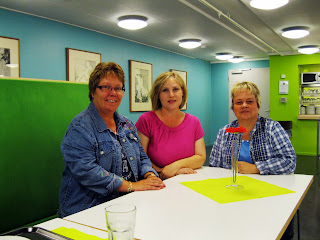
| Laila, me, and Liv at the Statsarkivene in Oslo |
Later that day, my uncle invited us to sail on his sailboat. Strange, but this seemed rather fitting on this day. So my son, me, and my father set out to meet my uncle and his significant other at their boat. It was a surprisingly gorgeous evening after a bit of rain in the afternoon. The water was beautiful; the view was extraordinary. What a wonderful way to spend the evening. We found a spot to anchor for a while and have some coffee and dessert. On this evening, being out at sea was in my blood. My ancestors had taken to the seas and at least one had died there... who knows how many there are I will never know about, because I'm guessing some of those pesky Vikings who traveled the world were related to me.
| My son and uncle's dog sailing. Scenes on the fjord below. |
Thanks for tuning in. My last few days in Norway will be posted in the next couple of days.
Subscribe to:
Posts (Atom)